Sometimes, people see the results without seeing the sacrifices behind them.
One of the lessons I have learnt about leadership is that people often see the success but rarely see the work, sacrifices, uncertainty and difficult choices that make it possible. They see the results, but not always the process. They see the opportunities people receive but may not see the responsibilities that come with them.
I experienced this while building a culture of research, innovation and grantsmanship at Summit University, Offa.
As a young university, we knew that developing a strong research culture would require more than good intentions. We needed people who were willing to learn, work collaboratively, meet demanding deadlines and grow with the vision. We also needed to create an environment that would enable them to succeed.
I invited colleagues to participate in our grantsmanship initiative, but only a few responded. Fortunately, we had recently completed community training in drone building and piloting. Some of the young participants, who were preparing to gain admission into the University, chose to stay and participate in grantsmanship training. They became part of the team that helped lay the foundation for our research and innovation efforts.
Our initial team comprised five SSCE holders who had not yet gained admission into the University, five undergraduate students, two bachelor's degree holders and about five master's degree holders. I was the only PhD holder and served as the team leader.
It was not the conventional composition one might expect of a research and grantsmanship team. Yet, these young people and graduates were willing to learn, take responsibility and work towards a shared goal. I saw an opportunity to develop people while building institutional capacity.
We worked long hours, sometimes day and night, preparing proposals, developing budgets and meeting demanding deadlines. We provided breakfast and lunch to support the team and introduced reimbursements for data and internet connectivity. These arrangements were not simply benefits; they were practical measures to support people undertaking demanding work and to create an environment in which they could contribute effectively.
Within two months, we secured our first international grant, titled Artificial Intelligence for Females in STEM (AI4FS). Some people doubted the achievement until implementation began.
Within 12 months, we had secured approximately four grants, all focused on Artificial Intelligence and gender. One of these was Artificial Intelligence for Women in Aquaculture (AI4WA). Through these projects, we were beginning to establish a distinctive niche for Summit University at the intersection of AI, gender and innovation.
As the work expanded, we established research and project offices in a quieter part of the campus. The space gradually became a hub of activity, sustained by team members who showed up consistently, collaborated and remained committed to meeting deadlines.
However, as the results became more visible, perceptions began to change. Some people viewed the Research and Innovation Unit as an elite group. Team members were sometimes referred to as “RIU people,” as though they belonged to a privileged circle.
I found this instructive. From the outside, people could see the office, the meals, the internet support and the grant announcements. What was less visible were the long hours, the pressure of deadlines, the constant preparation of proposals and the responsibility to deliver on the projects we had secured.
This is not to suggest that every perception of privilege is unfounded or that every allocation of resources is automatically justified. Leaders must be able to explain why resources are committed to particular initiatives and what the institution expects in return. In our case, the intention was to create the conditions necessary for a team to build research capacity, develop proposals and deliver results that could benefit the wider University.
The experience also reinforced an important lesson about mentorship. We sometimes underestimate people because of their qualifications, age or stage of life. Yet, when people are given meaningful responsibilities, appropriate guidance and the opportunity to learn by doing, they can accomplish far more than we initially imagine.
Those young participants were not merely helping us prepare proposals. They were acquiring practical skills, confidence and experience that could shape their futures. They were learning how to develop projects, work under pressure, collaborate with others and contribute to a larger institutional goal. For me, this was as important as the grants themselves.
Looking back, I see the real achievement as more than the funding secured. It was the capacity we built, the people we developed and the foundation we laid for the University's future research and innovation activities. An opportunity that began with a relatively small team had the potential to create value far beyond the people directly involved.
This experience taught me that leadership involves more than creating opportunities. It requires providing the support people need to use those opportunities productively, holding them accountable for results and ensuring that the benefits extend beyond the immediate team.
Sometimes, what appears to be privilege is the visible side of a responsibility whose demands remain unseen. The real question is not simply who receives an opportunity, but what that opportunity enables them to build, how responsibly they use it and whether the institution ultimately benefits.
Leadership must create opportunities, but it must also create value from them. When people are equipped, trusted and challenged to do meaningful work, an opportunity intended for a few can become a lasting benefit for many.
The stories are many. The lessons are even more.
---
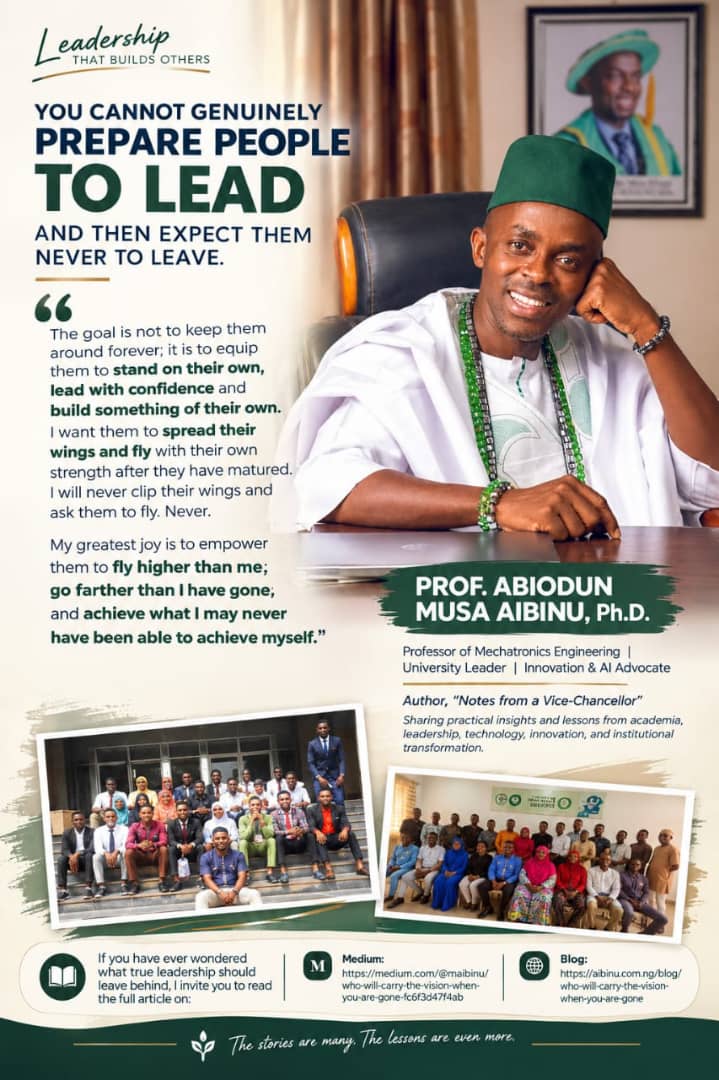
Prof. Abiodun Musa Aibinu, Ph.D.
Professor of Mechatronics Engineering | University Leader | Innovation & AI Advocate
Author, Notes from a Vice-Chancellor
Sharing practical insights and lessons from academia, leadership, technology, innovation and institutional transformation.