
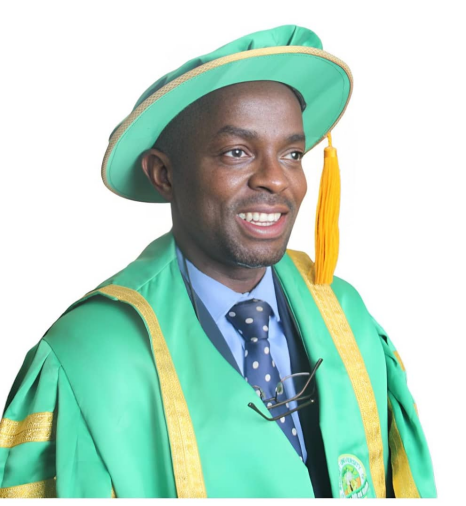
Prof. Abiodun Musa Aibinu (PhD)
2nd Vice-Chancellor, Summit University, Offa
Chief Executive & Academic Officer
“Transitioning to renewable energy is not just an environmental imperative; it is an economic and operational necessity that guarantees uninterrupted learning, research resilience, and institutional self-reliance.”
Sustainability, Renewable Energy and Progress Towards Net Zero
Deploying decentralized solar energy across academic, residential, laboratory, and administrative infrastructure while pioneering AI for clean energy research and institutional resilience.
Sustainability and energy resilience have formed an important part of my institutional development agenda. Recognising the operational and financial challenges associated with unreliable electricity supply, I promoted renewable energy solutions as part of the University's infrastructure development strategy. These interventions have been complemented by research and innovation activities in clean energy and environmental sustainability, with the broader objective of improving institutional resilience, operational efficiency and progress towards a more sustainable energy model.
Selected Strategic Initiatives & Outcomes
Key interventions advancing energy resilience, operational efficiency, and environmental sustainability:
14 Solar-Powered Campus Buildings
Developed renewable energy initiatives covering 14 solar-powered campus buildings.
Cross-Campus Infrastructure Deployment
Deployed solar energy solutions across selected academic, administrative, research, library, laboratory and residential facilities.
Grid Independence & Generator Fuel Reduction
Used renewable energy interventions to reduce dependence on the national electricity grid and fuel-powered generators.
Operational Efficiency & Power Reliability
Improved energy reliability and operational efficiency across selected University facilities.
Institutional Planning Integrated with Sustainability
Integrated sustainability considerations into infrastructure development and institutional planning.
Artificial Intelligence for Clean Energy Research
Supported research and innovation in Artificial Intelligence for Clean Energy and related areas through research partnerships and externally funded projects.
Academic & Research Green Agenda Integration
Promoted renewable energy and environmental sustainability as components of the University's academic, research and institutional development agenda.
Measurable Trajectory Towards Net Zero
These interventions represent measurable progress towards a more energy-efficient, resilient and environmentally sustainable university environment.
Technical Evidence Table • Solar Energy Deployments
Audit of solar energy installations, capacities, installation years, and funding sources across Summit University:
| S/N | Facility | Solar Capacity | Year Installed | Funding Source |
|---|---|---|---|---|
| 1 | Engineering Laboratory | 3.5 KVA | 2023 | Research Grant |
| 2 | Microbiology Laboratory | 3.5 KVA | 2023 | Donation |
| 3 | Research and Innovation Unit | 5 KVA | 2022 | Research Grant |
| 4 | Administrative Building | 3.6 KVA | 2023 | Research Grant |
| 5 | University Library | 3.5 KVA | 2023 | Donation |
| 6 | Postgraduate Building | 3 KVA | 2024 | Internally Generated Revenue |
| 7 | Mass Communication Studio | 3.5 KVA | 2025 | Donation |
| 8 | Mass Communication Building | 3.5 KVA | 2023 | Donation |
| 9 | Science Lecture Room | 3 KVA | 2025 | Internally Generated Revenue |
| 10 | Moremi Hostel | 5 KVA | 2026 | Donation |
| 11 | Lateefah Okunu Hostel | 10 KVA | 2025 | Donation |
| 12 | Women Council Hostel | 5 KVA | 2026 | Donation |
| 13 | IFF Accounting Laboratory | 10 KVA | 2025 | Donation |
| 14 | NITDA Laboratory | 6 KVA | 2025 | Donation |
| 15 | Entrepreneurship Building | 5 KVA | 2026 | Internally Generated Revenue |
| 16 | Lagos Council Hostel | 6 KVA | 2026 | Internally Generated Revenue |
| 17 | MBashir Building | 3.5 KVA | 2023 | Internally Generated Revenue |
| TOTAL CUMULATIVE SOLAR CAPACITY: | 82.6 KVA | 2022 – 2026 | 17 Facilities Fully Solar-Energised | |
Clean Energy Research & Artificial Intelligence Synergy
Combining practical campus renewable deployment with cutting-edge externally funded research:
BP4CC & AI for Clean Energy Research
Research Team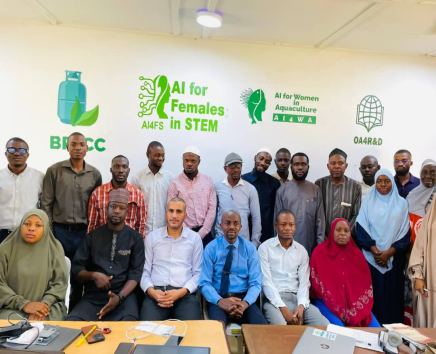
Prof. Abiodun Musa Aibinu with researchers and academic partners from the BP4CC (Bio-resources & Clean Cooking), AI4FS (AI for Females in STEM), and AI4WA initiatives—driving clean energy adoption, women empowerment in science, and AI-assisted environmental solutions.
Hands-On Clean Energy Workshop
Capacity Building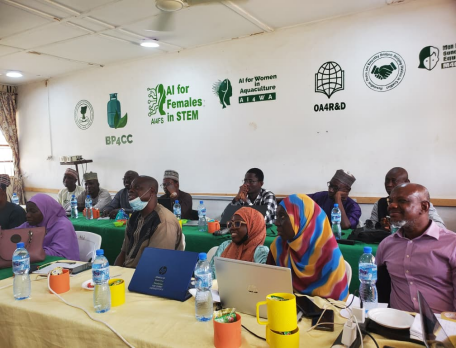
Interactive technical workshop session with faculty, postgraduate fellows, and researchers exploring artificial intelligence applications in clean cooking energy, biomass conversion, renewable energy modeling, and climate resilience frameworks.