Reflections, lessons and experiences from the privilege of leading a university
Leadership leaves you with stories. Some are stories of success; others are stories of difficult decisions, experiments that did not work as expected, opportunities seized, and lessons learned along the way.
As I reflect on my journey as a Vice-Chancellor, I have increasingly asked myself a simple question: What happens to all these lessons when one leaves office?
That question gave birth to “Notes from a Vice-Chancellor.”
I did not start this series because I believe I have all the answers. Far from it. I started it because university leadership provides a unique classroom—one in which the lessons come daily, sometimes unexpectedly, and often at a considerable cost.
Over the course of my tenure, I have had the privilege of confronting some of the realities facing contemporary universities, particularly emerging institutions in Africa: attracting and retaining students, mobilising scarce resources, strengthening research culture, building institutional visibility, developing people, creating partnerships, improving infrastructure, positioning a university competitively, and making difficult decisions with limited resources.
There have also been moments that demonstrated what is possible when a university community shares a vision and works collectively.
One such experience was the successful hosting of the KU8+ International Conference. Hosting KU8+ taught me that a university can use a major academic gathering not merely to host people, but to reposition itself, build partnerships, showcase its capacity, and change how others perceive the institution.
Another important lesson has come from student enrolment. For a private university, enrolment is not merely about numbers; it is closely connected to sustainability, reputation, programme relevance, student experience, and the ability of an institution to communicate its value to parents and prospective students. Our enrolment drive taught me that a good university cannot afford to remain a well-kept secret.
Then there is resource mobilisation. A Vice-Chancellor quickly discovers that vision without resources remains largely an aspiration. Yet resources do not always have to come from traditional sources. Partnerships, philanthropy, grants, collaborations, goodwill, and innovative thinking can open doors that conventional budgeting cannot.
This connects directly with another area that has become particularly important to me: grantsmanship. Universities must increasingly build the capacity of academics to compete for research funding. Research should not end with publications; it should attract resources, solve problems, develop people, influence policy, and create measurable societal impact.
I have also learned the importance of university visibility and branding. Academic excellence is fundamental, but institutions must also learn how to tell their stories. Achievements that are not communicated are often achievements that the world never knows about. Strategic communication, digital presence, partnerships, conferences, community engagement, and consistent institutional branding are therefore no longer optional extras in university administration.
Behind all these experiences are deeper lessons about people, leadership, teamwork, mistakes, resistance to change, decision-making, governance, innovation, and institutional transformation.
And those are the stories I want to tell.
“Notes from a Vice-Chancellor” will therefore not be a celebration of a tenure or a catalogue of achievements. It will be a collection of practical reflections on what worked, what did not work, what I would do differently, and what university leadership has taught me.
I hope these notes will be useful to aspiring Vice-Chancellors and other emerging university leaders who may one day find themselves carrying the responsibility of leading an institution. If some of the lessons I have learned can help another leader avoid a mistake, recognise an opportunity earlier, or make a better decision, then sharing them would have been worthwhile.
But I also hope this becomes a conversation with serving and former Vice-Chancellors. There is an enormous reservoir of leadership experience within our universities that is rarely documented. Imagine what younger university leaders could learn if more former Vice-Chancellors openly shared not only their successes, but also their difficult moments, failed initiatives, unexpected discoveries, and lessons from the corridors of university leadership.
This series will explore the realities of university leadership, from enrolment and resource mobilisation to research, grantsmanship, artificial intelligence, innovation, branding, people development, and the future of higher education in Africa.
Occasionally, I will also write about the human side of leadership—the decisions that keep a Vice-Chancellor awake at night, the importance of building the right team, managing expectations, dealing with setbacks, recognising when circumstances have changed, and knowing when to change direction.
Most importantly, these will be notes, not prescriptions.
Every university is different. Every leadership environment is different. But experiences can travel, and lessons can be shared.
As I begin this journey, I invite aspiring, serving, and former Vice-Chancellors, academics, administrators, students, policymakers, industry leaders, and everyone interested in the future of higher education to join the conversation.
Perhaps somewhere within these notes, someone preparing for university leadership will discover an idea worth trying.
Perhaps a serving Vice-Chancellor will recognise a challenge we share.
Perhaps a former Vice-Chancellor will add a lesson that the next generation needs to hear.
And perhaps, collectively, we can create a body of practical knowledge about university leadership that extends beyond our individual tenures.
Welcome to “Notes from a Vice-Chancellor.”
The stories are many.
The lessons are even more.
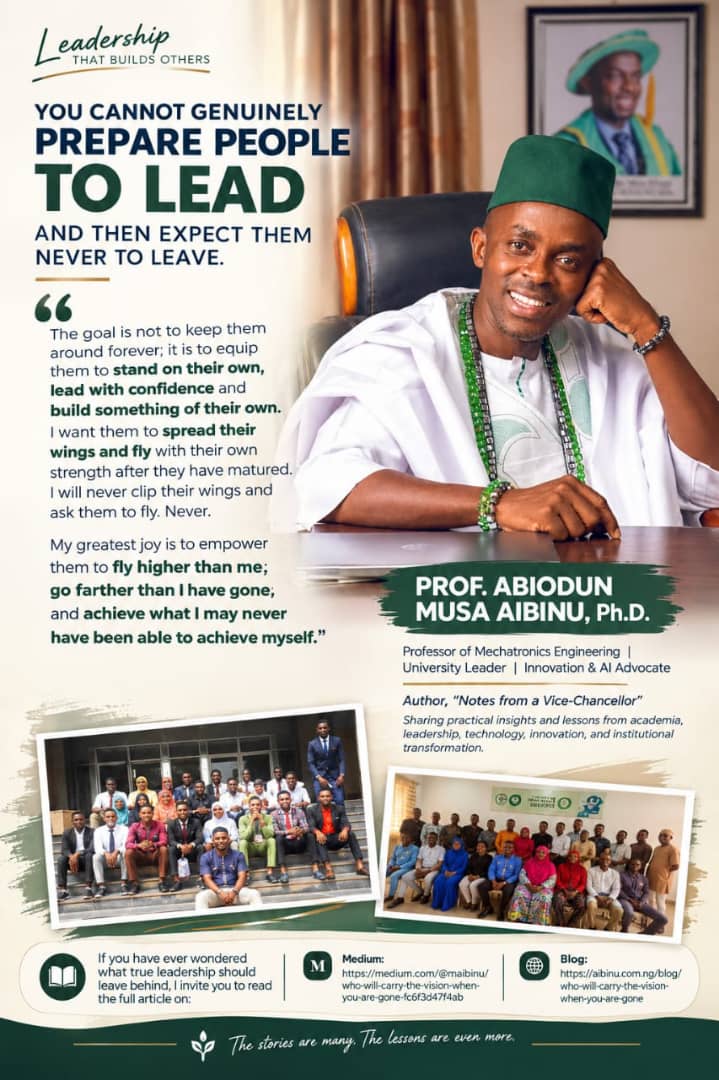
Prof. Abiodun Musa Aibinu, Ph.D.
Professor of Mechatronics Engineering | University Leader | Innovation & AI Advocate
Author, Notes from a Vice-Chancellor
Sharing practical insights and lessons from academia, leadership, technology, innovation, and institutional transformation.