What experience, mistakes, relationships and time have taught me about building an academic career
If I could sit across the table from the young academic I once was, there are many things I would tell him. I would tell him that an academic career is much bigger than publishing papers, attending conferences, winning grants, securing patents, supervising students and waiting for the next promotion.
I would tell him not to wait to be discovered. Work hard, but also learn to communicate what you know, build relationships, make your work visible and take calculated risks. Competence matters, but competence that never reaches beyond the corner where it was developed may never achieve its full impact.
But there is one lesson I would emphasise above all others: never forget that behind every student you teach is a human being whose life may be changed by the way you treat them.
When I look back across my academic journey, one of my greatest rewards has not been the titles I have held or the positions I have occupied. It has been watching students and mentees grow, from the International Islamic University Malaysia to the Federal University of Technology, Minna, and now at Summit University, Offa.
Some of my most unforgettable moments have been the farewells. Students whom I taught and mentored have come to say goodbye as they moved on to another chapter of their lives. What begins as an ordinary farewell can suddenly become deeply emotional. The students cry. I cry. Members of the team cry.
There is a particular sadness in watching a student you have invested in leave. You remember their struggles, mistakes and uncertainties, and then you see them become confident enough to build something of their own.
Looking back, I have come to understand one of the beautiful contradictions of mentorship: you invest in people so that one day they become strong enough to leave you.
That is why I would tell the young academic I once was to look after his students. Do not see them merely as names on a class list or numbers on a result sheet. Know them. Pay attention to their struggles. Encourage them. Correct them when necessary, but always with the intention of helping them grow.
I remember a mentee who once went for an interview and realised that he had forgotten the original copies of his credentials. He called me and said he would return to the laboratory. I told him not to return until he had secured the appointment letter.
About 24 hours later, he called again. He had travelled home, collected the documents, returned to the interview venue, pleaded with the panel and was about to be interviewed. The rest is history. He is a colleague today.
I also remember a student who was considering dropping out of university. While waiting for transport fare from home, the student would come to see me simply to say hello. Eventually, the student graduated as the best final-year project student and is now a lecturer at a university.
These experiences taught me something simple: sometimes, showing up for a student at the right moment can change the direction of a life.
I would also tell the young academic to protect his students. Academic environments are not perfect. There can be “hawks” who see a student's vulnerability as an opportunity for personal advantage rather than an opportunity to nurture a young life.
Never become one of them.
Students should never have to buy your favour, compromise their dignity or offer personal loyalty to receive what they are legitimately entitled to. The greater your influence over a student, the greater your responsibility to use it wisely.
I would tell him to find mentors too. I have benefited greatly from people whose advice, encouragement, criticism and example shaped my journey. Some opened doors; others challenged my thinking; some simply showed me what was possible.
Find people you respect, ask questions, listen and learn. But as you grow, become the person you once needed. Do not feel threatened when someone you have mentored becomes better than you. If someone becomes better because you helped them, that is part of your legacy.
I would also tell him to keep learning. Look beyond your immediate discipline. Learn grantsmanship, collaborate across disciplines, understand industry and government, communicate your work beyond academic journals, and embrace technology and artificial intelligence. Your discipline gives you depth, but curiosity gives you range.
And never confuse being busy with making an impact. Ask yourself: Did my research solve a problem? Did my teaching change a student's life? Did I create an opportunity? Did I help someone?
Build relationships, not just a CV. Protect your character as carefully as you build your reputation. There will be promotions and disappointments, recognition and rejection. Through all these seasons, do not sacrifice your integrity for a position or temporary advantage.
Titles come and go. Your name stays with you.
And finally, enjoy the journey. Do not spend your entire academic career waiting for the next promotion. Enjoy working with your students, your research, the discovery of something new, and the privilege of watching someone you once taught become a professional, a leader or even a colleague.
Perhaps that is one of the greatest privileges of being an academic: you become part of someone's journey without owning their destination.
If I could speak to the young academic I once was, I would tell him that his career will not ultimately be measured only by the papers he publishes, the grants he wins, the positions he occupies or the awards he receives.
It will also be measured by the students who became better because he taught them, the young academics who became stronger because he mentored them, the colleagues he encouraged, the problems he helped solve and the opportunities he created for others.
And perhaps, years from now, when a former student returns to say goodbye, or simply comes back to say, “Thank you, Sir,” and you find yourself struggling to hold back your tears, you will understand something that no promotion can fully capture.
You were privileged to walk with them for a part of their journey. You helped them grow. And then you let them go.
That, perhaps, is the real measure of an academic career.
Not simply that you built a successful career, but that, along the way, you helped build people who could go further than you.
If I could speak to the young academic I once was, this is what I wish someone had told me: never underestimate the power of showing up for another person.
Most of us can look back and remember someone who stood for us when we needed help, believed in us when we doubted ourselves, opened a door for us, corrected us when we were going in the wrong direction, or simply refused to give up on us.
We should tell those stories while the people who shaped our lives are still here. We should not wait for a funeral, a retirement or an award ceremony before saying, “You made a difference in my life.”
And if you cannot tell your own story today, perhaps share this one. Somewhere, a student or a young academic may need to hear that someone believes in them.
What I wish someone had told me is this: build your career, but never forget to build people. Because one of the greatest measures of an academic life is not only what you achieve, but the lives that become better because you chose to show up for them.
The stories are many. The lessons are even more.
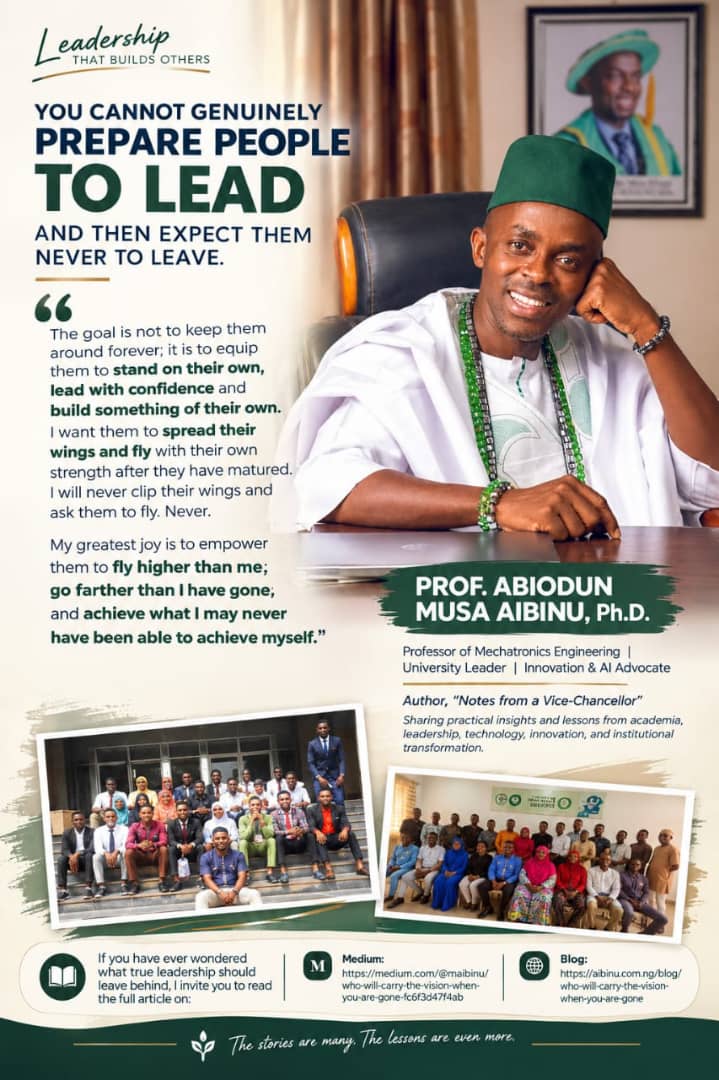
Prof. Abiodun Musa Aibinu, Ph.D.
Professor of Mechatronics Engineering | University Leader | Innovation & AI Advocate
Author, Notes from a Vice-Chancellor
_Sharing practical insights and lessons from academia, leadership, technology, innovation, and institutional transformation._