Lessons about people, resistance, innovation and the hidden cost of leadership
Before becoming a Vice-Chancellor, I had a vision, a strategy document and an implementation plan. I knew the reforms I wanted to introduce and the difference I hoped to make. But my first year taught me that leadership is rarely as straightforward as it appears on paper.
I discovered that leadership is not simply about managing systems, allocating resources or implementing policies. It is about people, competing interests, difficult decisions and the emotional strength to keep moving when your intentions are misunderstood.
Some of my most important lessons came from unexpected places.
People Are the Most Complex Variable
As an engineer, I am accustomed to investigating faults, identifying causes and finding solutions. Yet, I learnt that problems are not always what they appear to be.
I remember an occasion when software we had developed was reported not to be working. I visited the office with members of my team to investigate. To our surprise, we discovered that the computer on which the software was supposed to run had not even been switched on.
The problem was not the software; it was how it was being used.
That experience reminded me not to accept every complaint at face value. Sometimes, the only way to understand a problem is to visit the scene, ask questions and establish the facts. Systems can be designed, procedures established and policies communicated, but understanding people remains one of leadership's most difficult responsibilities.
When Resistance Becomes Acceptance
When I introduced Artificial Intelligence (AI) at Summit University, some colleagues questioned its relevance to Management, Social Sciences and Mass Communication. Others felt the University was becoming too STEM-oriented or placing too much emphasis on women in STEM.
Yet, we needed to prepare our students for a changing world and establish a distinctive identity in an increasingly competitive university environment.
One experience remains particularly memorable. A colleague who initially resisted the idea of AI began to reconsider his position after making further enquiries and receiving a call from a professional colleague about AI. Within a week, his attitude had changed. He eventually became a champion of AI in communication, representing me at events and delivering lectures on the subject. Other colleagues from non-STEM backgrounds also took leading roles in AI and grantsmanship.
I take genuine pleasure in seeing people champion ideas they once questioned. Their transformation taught me not to write people off too quickly. Resistance does not always mean deliberate opposition; sometimes, people simply need the opportunity to understand something new.
The person questioning your vision today may become one of its strongest champions tomorrow. A leader must know when to stand firm and when to give people room to learn, grow and change.
When Success Is Mistaken for Privilege
One of my most rewarding experiences was building capacity in research grantsmanship. Our initial team comprised six SSCE holders who had not yet gained university admission, five undergraduates, two bachelor's degree holders and about five master's degree holders. I was the only PhD holder and served as the team leader.
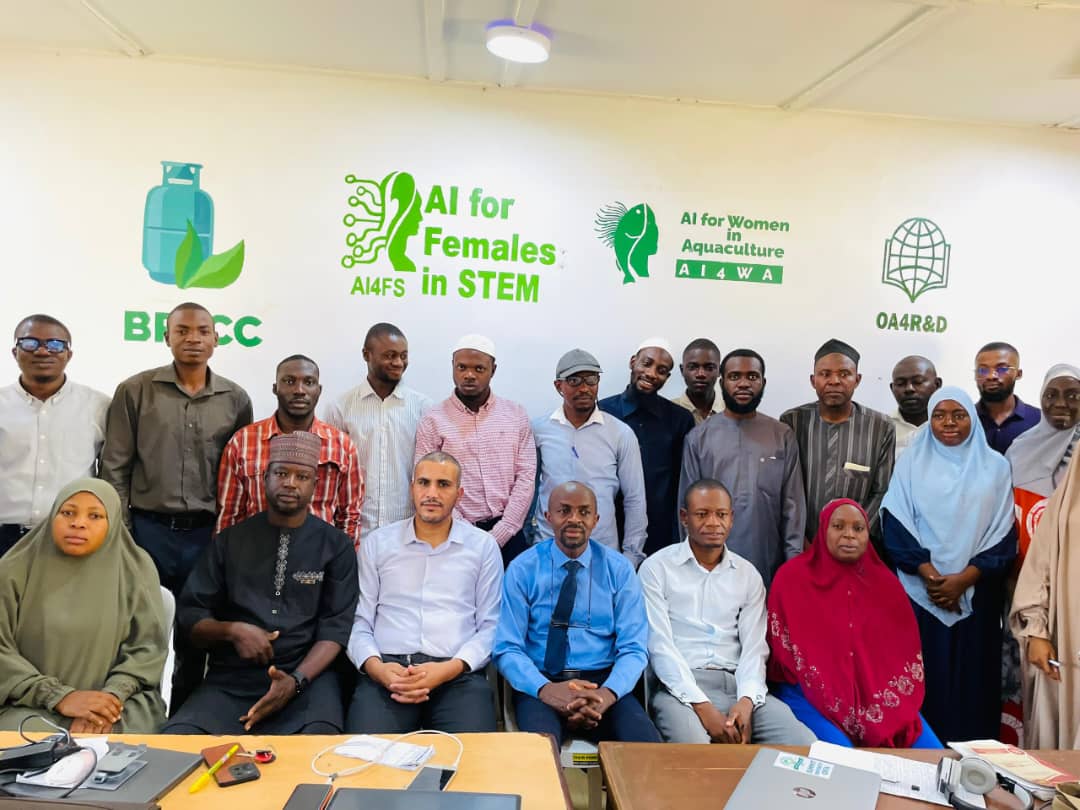
We worked long hours, learning, writing proposals and pursuing opportunities that many of us had never encountered before. Within two months, we secured our first international grant, Artificial Intelligence for Females in STEM (AI4FS). Within twelve months, the team had secured about four grants, including Artificial Intelligence for Women in Aquaculture (AI4WA).
As the results became visible, some people saw the achievements without necessarily seeing the effort, sacrifices and learning behind them. The team was sometimes referred to simply as the “RIU people,” with little recognition of the hard work, learning and personal development behind the achievements.
What mattered to me was not only the grants we secured, but also the skills, confidence and experience that team members developed through the process. That experience reinforced my belief that leadership is not merely about achieving results; it is also about creating opportunities for others to develop the capacity to produce them.
People grow when they are trusted with meaningful responsibilities, given guidance and allowed to learn through experience. Sometimes, what others perceive as privilege is the product of unseen effort, mentorship and sacrifice.
The Lesson of Authoritarian Democracy
During my first year as Vice-Chancellor, I fully embraced what I describe as authoritarian democracy, a leadership philosophy that combines consultation and openness with the courage to make firm decisions.
I believe in listening to people, respecting opposing views and considering advice. However, consultation does not remove the leader's responsibility to make the final decision and accept accountability for its consequences.
Several experiences reinforced this conviction. One involved a technician who insisted that the unused engine oil in our generator had turned into water. He had facilitated the purchase of the oil from a supplier less than three months earlier, and the generator had not been used since servicing. Although some people supported his explanation, my knowledge of chemistry made me question its validity.
I insisted on replacing the technician. Subsequently, a University officer took over the operation of the generator, eliminating our previous dependence on the technician whenever we needed to use it. Remarkably, the same engine oil remained in use for another two years, and the generator continued to function properly. Today, it is still working well.
That experience reinforced my belief that leadership sometimes requires the courage to question prevailing opinions, challenge established practices and make difficult decisions based on evidence and sound judgement.
That was just one of several occasions when I had to make decisions despite opposing opinions. For me, authoritarian democracy is not about silencing people or assuming that the leader is always right. It is about listening without surrendering judgement, consulting without becoming paralysed by indecision, and remaining accountable for the decisions one makes.
A leader must be democratic enough to listen to everyone, yet decisive enough to take responsibility for the final decision.
The Family That Quietly Pays the Price
Perhaps my most personal lesson was that the University is not the only one that pays for a Vice-Chancellor's commitment. The family does too.
At a residential university, work rarely ends when you return home. Calls, messages and urgent student welfare issues can interrupt family time without warning. After a day of meetings, there may still be memos to read and approvals to issue.
Attending your child's Open Day requires planning, and even then, an emergency may disrupt it. You may be physically present at home but emotionally exhausted, with little energy left for the people who need you most.
I would hesitate to recommend the office to someone raising very young children without first explaining its demands. Behind many successful administrators is a family that quietly sacrifices time, companionship and precious moments.
The tenure will end, but childhood will not wait. Some moments cannot be recreated, and some absences cannot be compensated for later.
You must serve the University faithfully without becoming a stranger to your own family.
What Remains After the Office
My first year taught me that leadership is measured by more than policies introduced, grants secured or reforms implemented. It is also measured by the people developed, the trust preserved and the opportunities created for others.
You will not always be understood. Some will resist your ideas; others may eventually champion them. You will make difficult decisions and face moments that test your patience and convictions. Throughout it all, you must remember that the office is temporary, but the consequences of your leadership can endure.
Ultimately, the true test of leadership is whether the institution and its people are better because you served, whether others grew through the opportunities you created, and whether you fulfilled your responsibilities without losing sight of the people who matter most.
The office will eventually belong to someone else. What we build, the people we develop and the impact we leave behind are what truly matter.
The stories are many. The lessons are even more.
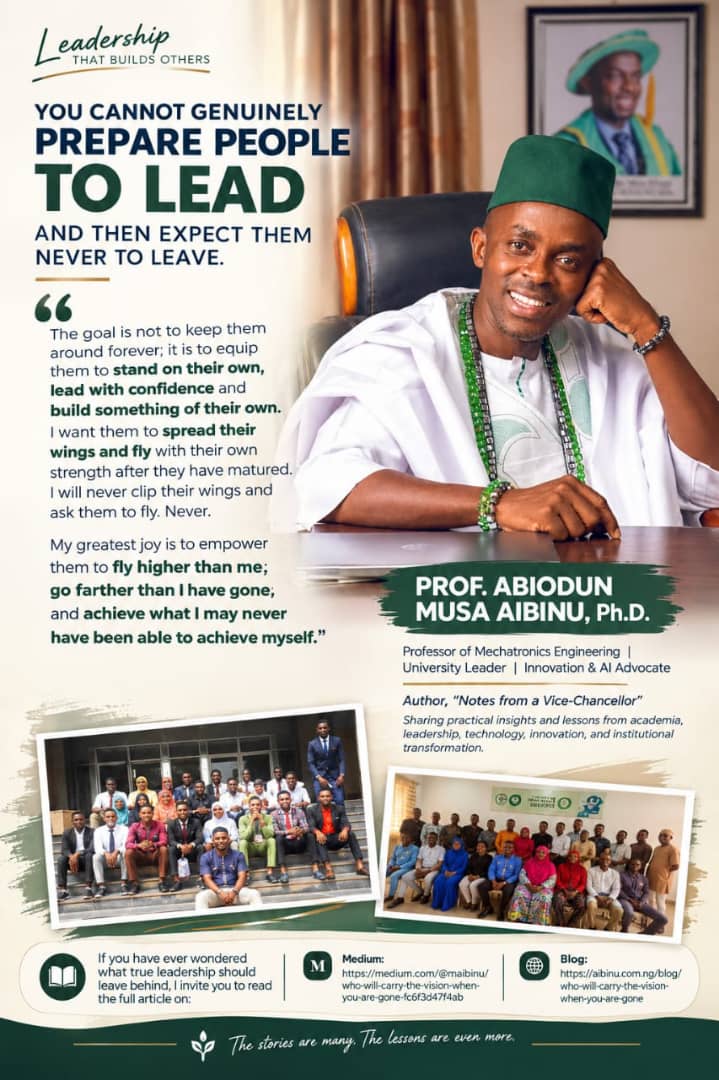
Prof. Abiodun Musa Aibinu, Ph.D.
Professor of Mechatronics Engineering | University Leader | Innovation & AI Advocate
Author, Notes from a Vice-Chancellor
Sharing practical insights and lessons from academia, leadership, technology, innovation, and institutional transformation.